India's ₹1 Trillion Creator Economy Opportunity, & Why Brands Can No Longer Ignore Creators!
India's ₹1 Trillion Creator Economy Opportunity: Why Creators Are Becoming Economic Drivers
For years, the creator economy has been framed in language that feels almost quaint now, as though it belonged to an earlier, more innocent phase of the internet. Creators were described as influencers, content producers, or, at best, marketing partners—useful intermediaries who helped brands reach audiences scattered across social platforms. Their success was tallied in metrics that felt both precise and strangely hollow: likes, followers, impressions, engagement rates. It was a vocabulary borrowed from advertising, not economics.
That framing is beginning to collapse under the weight of its own inadequacy. What is unfolding in India today is not merely the maturation of a marketing channel but the emergence of something closer to an economic substrate—an invisible layer that shapes how demand is generated, how trust is built, and how transactions ultimately occur. Creators are no longer peripheral actors orbiting brands; they are increasingly central to how value itself is created and distributed.
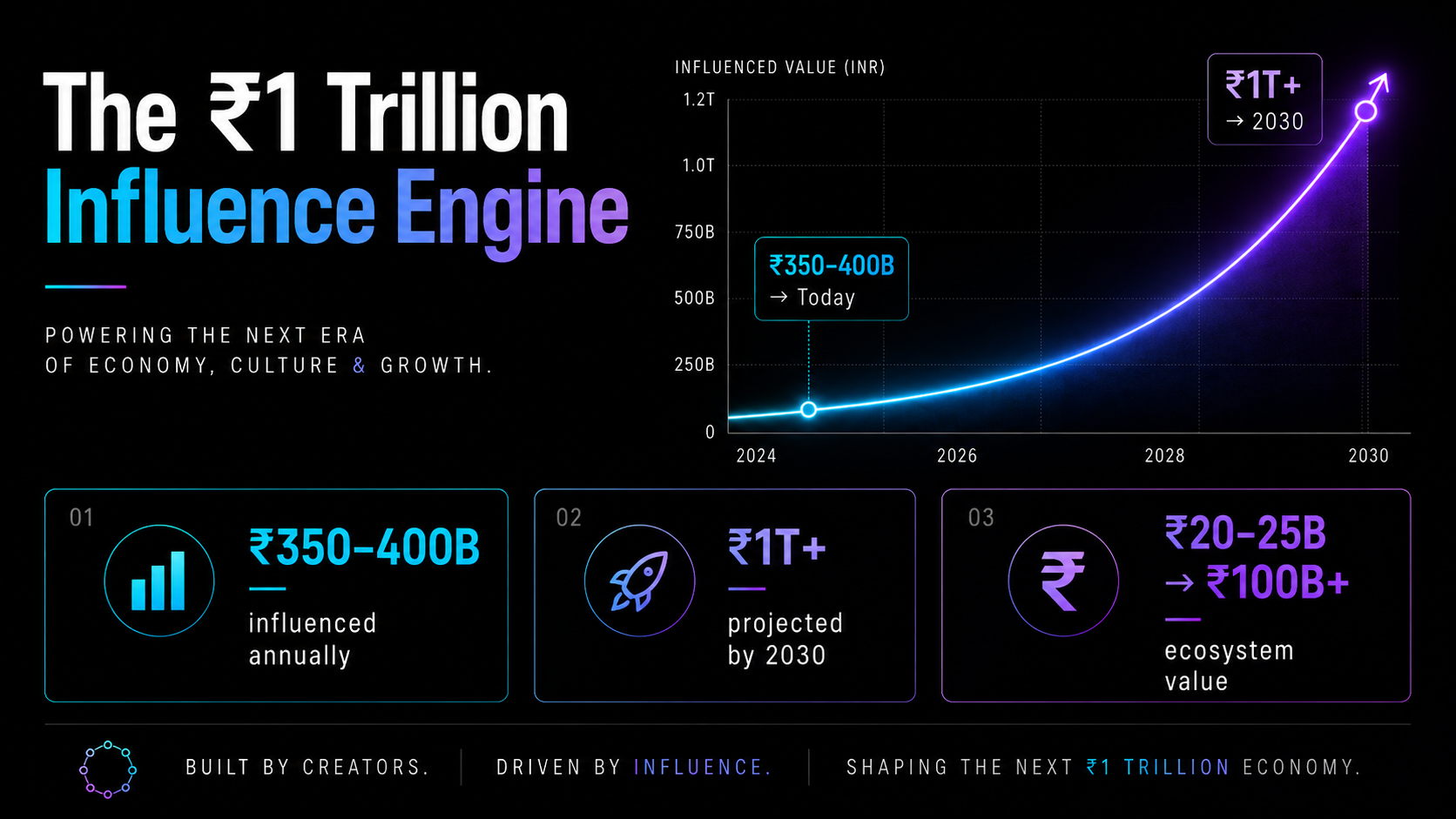
The numbers, when taken together, suggest a shift that is difficult to ignore. Creators already influence an estimated ₹350–400 billion in economic activity each year, a figure that is projected to swell past ₹1 trillion by the end of the decade. Meanwhile, the broader ecosystem that supports them—platforms, agencies, tools, and services—is expected to grow from roughly ₹20–25 billion today to over ₹100 billion in the coming years. These are not the contours of a niche industry; they are the outlines of a system that is beginning to rival more established sectors in both scale and consequence.
The Creator Economy Is Becoming a Trillion-Rupee Influence Engine
There was a time, not long ago, when the influence of creators could be dismissed as ephemeral, a byproduct of fleeting trends and algorithmic whims. That time has passed. The scale at which creators now shape consumer behavior has reached a point where it begins to resemble infrastructure rather than entertainment, something closer to a utility than a novelty.
Consider the trajectory: hundreds of billions of rupees in annual economic influence today, with a clear path toward a trillion. At the same time, the ecosystem that enables this influence—comprising platforms, agencies, analytics firms, and creator tools—is expanding rapidly, suggesting that the underlying machinery is becoming more sophisticated even as the surface appears increasingly seamless. What once looked like a loose collection of individuals posting content now resembles a coordinated, if decentralized, system of value creation.
This shift has quietly altered the nature of the conversation. It is no longer sufficient to speak of engagement or reach, as though these were ends in themselves. The more relevant question is how attention is converted into action—how a recommendation becomes a purchase, how a moment of trust becomes a transaction. In this sense, creators have become a crucial intermediary layer between businesses and consumers, one that is both more intimate and more scalable than traditional channels.
The Growth Story Is No Longer Urban
If the early chapters of India’s creator economy were written in the language of metropolitan aspiration—English-speaking audiences in cities like Mumbai, Bengaluru, and Delhi—the current chapter is being drafted in a far more diverse set of voices. One of the clearest signs of maturity in any market is its ability to transcend its original demographic boundaries, and here the creator economy offers a striking example.
Today, creator consumption in metro markets hovers around 65 percent, a figure that is almost indistinguishable from the 64 percent observed in Tier 2 and Tier 3 cities. The symmetry is telling: what was once an urban phenomenon has diffused across the country with remarkable speed. Gender, too, appears to exert little influence on participation, with creator-led content reaching roughly 63 percent of male audiences and 65 percent of female audiences. These are not the uneven patterns of a niche trend; they are the hallmarks of mainstream behavior.
Perhaps the most consequential development, however, lies in the rise of vernacular content. As millions of users come online in languages such as Hindi, Tamil, Telugu, Bengali, and Marathi, the creator economy is being reshaped from within. Content that once catered to a relatively narrow, English-speaking audience is now being reimagined for a far broader and more linguistically diverse population. This shift does more than expand the addressable market; it alters the very texture of the ecosystem, introducing new forms of expression, new cultural references, and new pathways to trust.
Why the Creator Economy Is Bigger Than Social Media
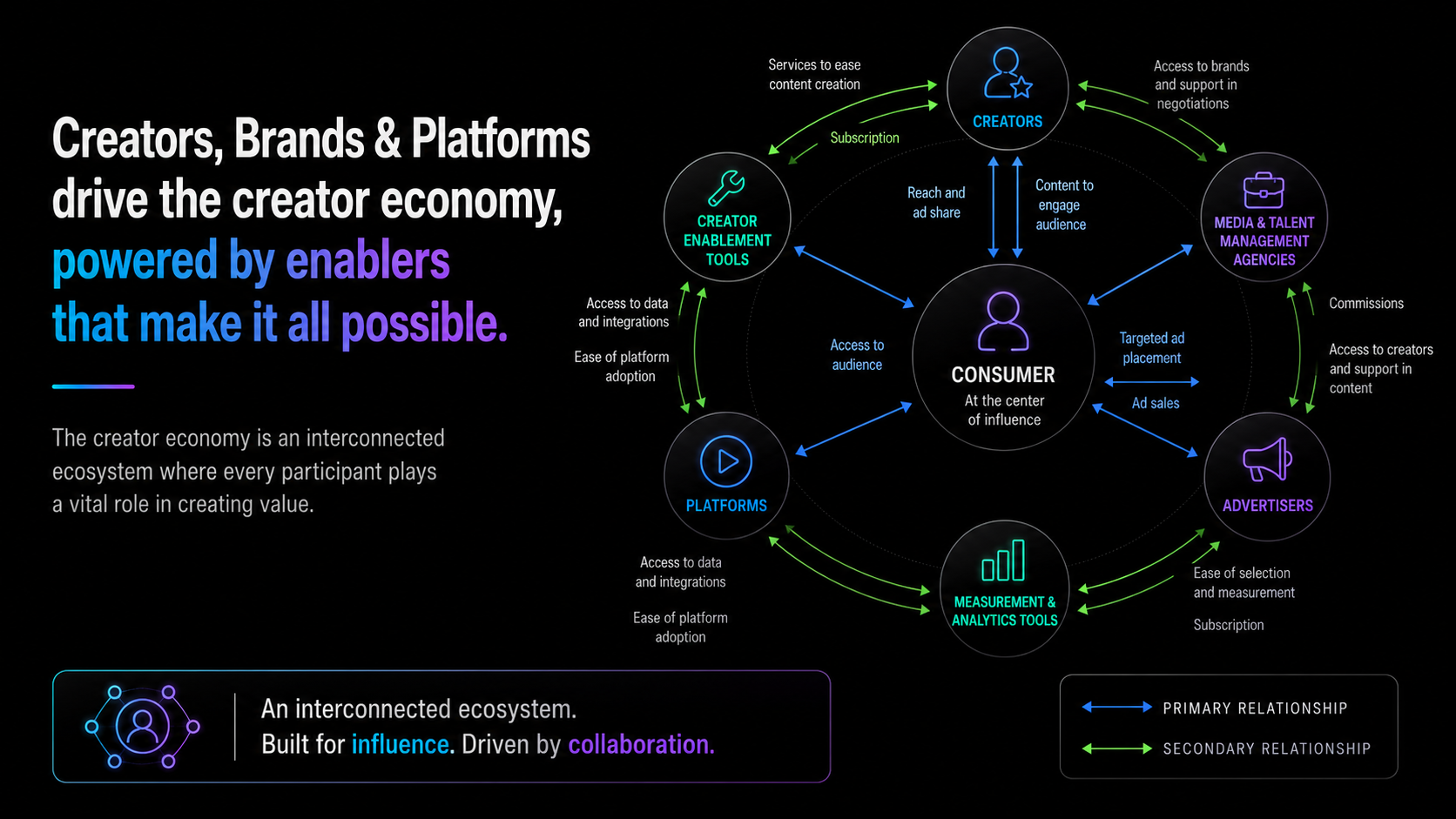
It is tempting to think of the creator economy as an industry defined by its most visible participants—the creators themselves—but this perspective obscures the complexity of what has emerged. In reality, the creator economy functions less like a single industry and more like an ecosystem, one in which multiple layers interact to produce outcomes that no single participant could achieve alone.
At its center sits the consumer, whose attention and trust are the ultimate currencies of the system. Surrounding them is a constellation of actors: creators who generate content and cultivate communities; platforms that facilitate discovery and distribution; advertisers who provide monetisation opportunities; agencies that broker relationships and manage talent; tools that streamline production and workflow; and analytics providers that attempt to measure what is, in many ways, still difficult to quantify.
This layered structure is not accidental. It mirrors the evolution of other digital economies, each of which has, over time, developed its own supporting infrastructure. E-commerce gave rise to logistics networks and payment systems; fintech produced compliance frameworks and lending platforms. The creator economy is now undergoing a similar transformation, moving from a loosely organized collection of activities to a more integrated, full-stack system. What began as content creation is becoming something closer to an economic architecture.
India's Biggest Problem Is Not Scale
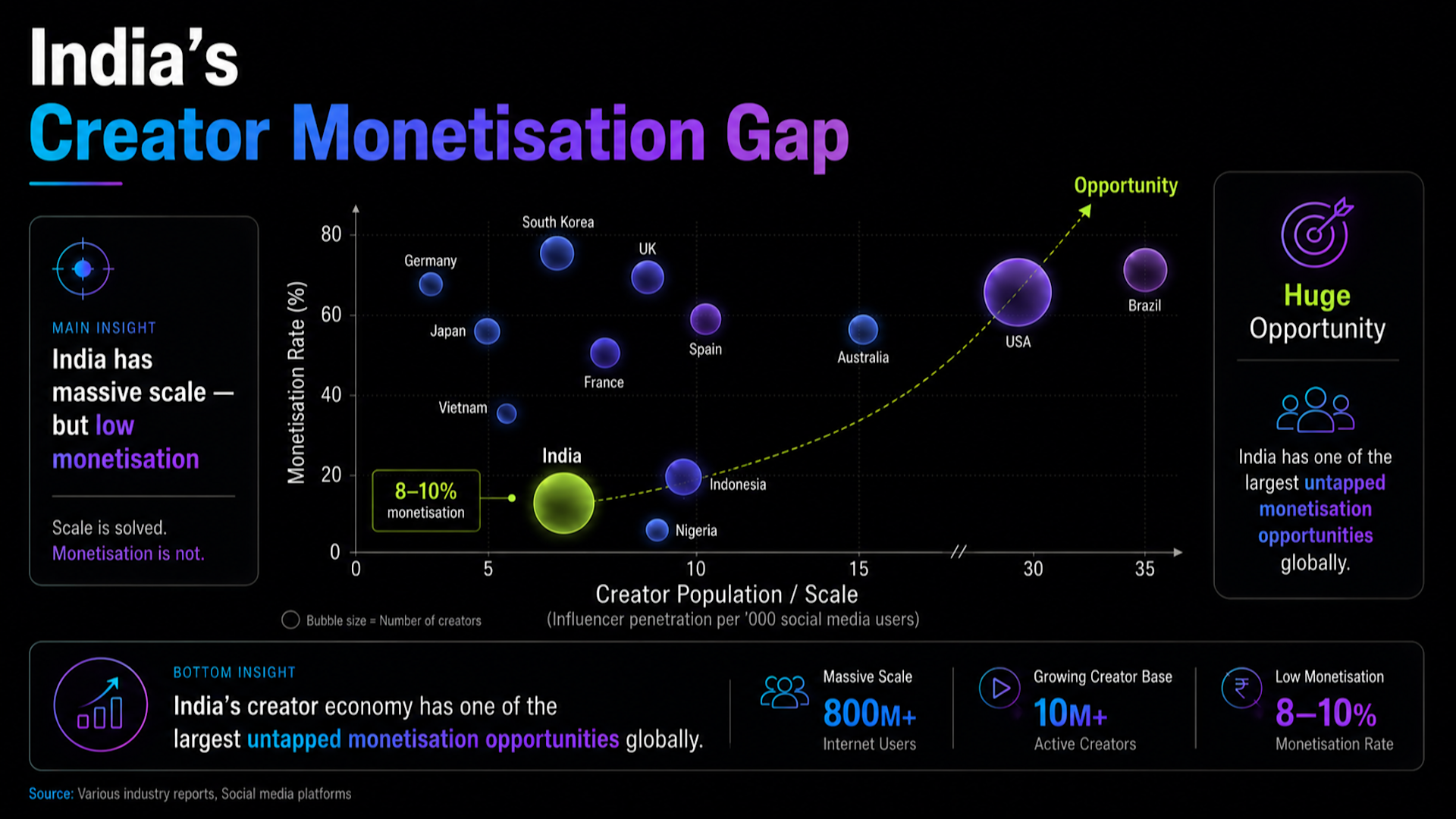
For all its momentum, the Indian creator economy is defined by a paradox that is as striking as it is consequential. The country has achieved extraordinary scale, boasting one of the largest creator populations in the world and a vast, engaged audience. And yet, when it comes to monetisation, it lags significantly behind more mature markets such as the United States, the United Kingdom, South Korea, and Germany.
Current monetisation rates in India hover between 8 and 10 percent, a figure that underscores the gap between attention and revenue. This disparity is not merely a statistical curiosity; it is the central tension around which the next phase of growth will revolve. The challenge is no longer to attract audiences—India has already done that at scale—but to convert that attention into sustainable economic value.
Addressing this gap will require more than incremental improvements. It will demand the development of robust monetisation infrastructure: more sophisticated creator commerce systems, deeper and more strategic brand partnerships, improved measurement frameworks that can link activity to outcomes, and financial products tailored to the unique needs of creators. In this sense, the most significant opportunities may lie not in creating more content but in building the systems that allow that content to generate value.
Where the Next Wave of Value Will Come From
To understand where monetisation might expand, one must first consider how consumer behavior itself is evolving. Increasingly, discovery—the moment when a consumer first encounters a product or idea—is mediated by creators, particularly through short-form video. Platforms have optimized for this mode of consumption, and users have adapted accordingly, turning to creators not just for entertainment but for guidance.
Certain categories have already become deeply intertwined with this dynamic. Fashion and beauty, for instance, have emerged as high-trust domains where creator recommendations can directly influence purchasing decisions. Comedy and entertainment continue to dominate in terms of reach, while newer sectors such as finance and technology are beginning to find their footing, suggesting that the model is both adaptable and expansive.
Brands, for their part, are responding with increasing urgency. Roughly 70 percent are expanding their creator marketing budgets, a shift that reflects not experimentation but conviction. The traditional customer journey—once a linear progression from television to search to purchase—has been reconfigured into something more fluid and, in many ways, more personal: creator to discovery to trust to purchase. As this pathway becomes more entrenched, the opportunities for monetisation multiply, extending across the entire ecosystem.
Why This Creates One of India's Largest Business Opportunities
When these threads are woven together, a picture begins to emerge—one that is both complex and, in its own way, inevitable. India possesses the essential ingredients of a thriving creator economy: scale, engagement, and a rapidly expanding audience. Brands are already investing heavily, and consumers have demonstrated a willingness to integrate creator-led discovery into their daily lives. What remains underdeveloped is the infrastructure that can translate this activity into sustained economic value.
This gap, however, is precisely what makes the moment so compelling. Opportunities abound across sectors: brands can refine their creator commerce strategies to more directly influence purchasing behavior; platforms can design more effective monetisation tools and revenue-sharing models; startups can build products that address the practical needs of creators, from workflow management to analytics; financial institutions can develop services tailored to a new class of digital entrepreneurs; and agencies can create more rigorous systems for attribution and measurement.
In this sense, the creator economy is no longer confined to those who produce content. It encompasses a wide array of businesses that enable, support, and amplify the creation of value. The question is not whether there is opportunity, but where within this expanding ecosystem one chooses to participate.
The Shift Is Already Happening
What is perhaps most striking about this transformation is how quietly it has unfolded. There has been no single moment of rupture, no clear dividing line between the old understanding of the creator economy and the new. Instead, the shift has occurred gradually, almost imperceptibly, as creators have moved from the margins of commerce to its center.
They now influence demand in ways that are both subtle and profound, shaping not only what consumers buy but how they think about brands and products. They accelerate discovery, compressing the distance between awareness and action, and they generate trust at a scale that traditional channels struggle to replicate. In doing so, they have become integral to the mechanics of modern commerce.
India, for its part, has already accomplished the most difficult task: building scale. The decade ahead will be defined by what comes next—by the systems, tools, and strategies that transform that scale into monetisation. Those who recognize this shift early, and who invest in the infrastructure that supports it, will be best positioned to capture the value that follows.
The question, then, is no longer whether creators matter. It is who will build the mechanisms that allow their influence to translate into the next ₹1 trillion of economic opportunity.